Inside a Youth Financial Literacy Internship: What Students Built


A good internship doesn't hand you busywork. It hands you something real to build, then lets you feel the weight of getting it right.
That's the version of a youth financial literacy internship that Diapers 2 Deposits ran this summer. Through the MCPS Summer RISE program, a team of student interns spent 50 hours building the actual resources that Baltimore students now use to learn about money. Not mock projects. Real ones, shipped.
The cohort wrapped this week. Here's what they built, and why the work maps so cleanly onto skills any first job will ask for.
What the interns built this summer
The output was heavier than most people expect from a 50-hour program.
By the end, the team had produced roughly 170 assessment forms across the curriculum: about 136 for high school and college lessons, and around 35 for elementary and middle school. They built reference cards for more than 100 publicly traded companies, each pairing a company profile with its ticker symbol so students learning to invest have something concrete to hold onto.
They also turned out a ten-page storybook teaching the Rule of 72, a ten-episode video series on why financial literacy matters, and a set of one-page guides for every tool on the D2D Money Hub. Those guides came in two versions, one for high school and college students and one written for elementary and middle schoolers, then got translated into Spanish so bilingual learners weren't left out.
That's a lot of finished work. The more interesting part is what building it taught them.
The Investor's Club: from company cards to a live leaderboard
The investing work started simple and got ambitious.
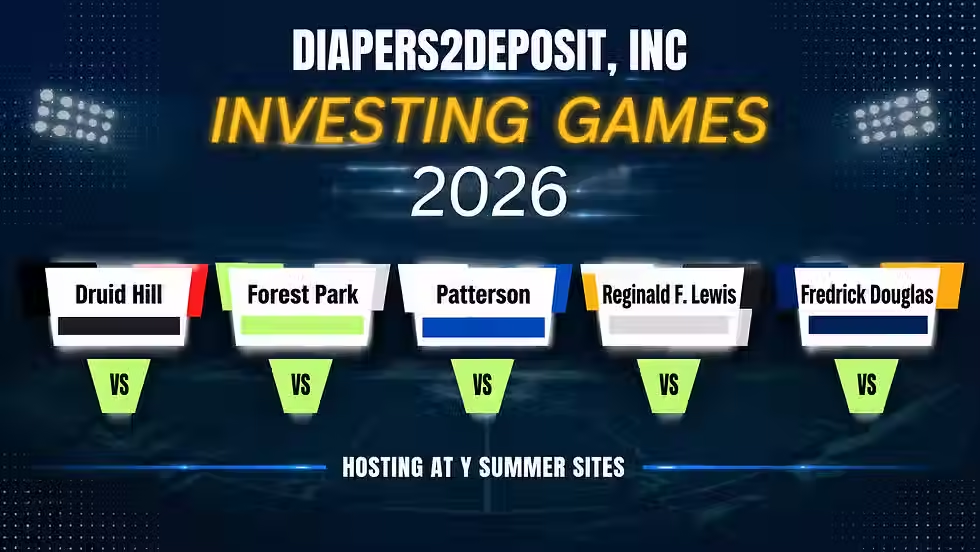
First the team built out the S&P 500 company cards, the reference set that helps students recognize real companies instead of abstract tickers. Then one intern designed a leaderboard that lets participating schools compare their investment performance against each other.
That's a real product feature, not a worksheet. It meant thinking about what makes a competition motivating, how to display standings clearly, and how to turn investing from a lecture topic into something students want to check on. The intern who built it walked away understanding the decision-making behind investing, the same idea at the heart of the Investor's Club. Hard to get that from a textbook.
Teaching by making
Some of the strongest learning came from building things meant to teach other kids.
The ten-page storybook on the Rule of 72 had to take a mental-math shortcut most adults don't know and make it land for a middle schooler. The video series had to hold attention across ten episodes. The bilingual one-pagers had to explain buying and selling investments simply enough for a younger reader without dumbing it down.
Writing to teach forces a kind of clarity that studying never does. You can't fake understanding when a ten-year-old is the audience. The interns who worked on these came out knowing the material cold, because they had to explain it plainly first.
The quiet skills: quality control, recruiting, and clean files
Not all of it was glamorous. The parts that weren't are the parts employers notice.
The team ran a full quality-control pass on the curriculum questions: checking formatting, catching inconsistencies, and making sure each assessment actually matched its lesson. Detail work, done carefully, at volume.
Two interns handled expense reporting, organizing and properly redacting transactions from a corporate card across a three-month window so the records were accurate and clean. Others supported recruiting, reviewing incoming applicants against the submission requirements, removing incomplete ones, moving qualified candidates toward interviews, and keeping a tracker current the whole way through.
Then everything got moved into a standardized folder structure so the next team can find it. Nobody puts maintaining a clean file system on a highlight reel. Every manager who has inherited a mess knows exactly how much it's worth.
What this teaches about careers
Somewhere in the middle of the program, the interns sat down with two working professionals: a financial advisor from Northwestern Mutual and a retired wealth management advisor. They talked through real career paths, what the day-to-day looks like, and how they got there.
That conversation did something the projects couldn't. It connected the work to a future. A student who just spent a week building investing resources gets to ask someone who does it for a living what the job is actually like.
Add it up and the internship taught the things that transfer to any workplace: managing a project to a deadline, doing detail work without cutting corners, explaining an idea so someone else gets it, and keeping your work organized enough that it outlives you. The financial literacy was the subject. Career readiness was the real curriculum. Diapers 2 Deposits was named an MCPS Summer RISE host for a personal finance and soft-skills career track this year.
FAQ
What is Summer RISE?
Summer RISE is a Montgomery County Public Schools work-based learning program that places students with local organizations for short summer experiences tied to real projects and career exposure.
Do interns need a finance background to take part?
No. The program is built to bring students up to speed. Diapers 2 Deposits interns complete financial literacy instructor training first, then apply it by building resources.
What kinds of projects do interns work on?
A mix: curriculum assessments, investing reference materials, educational content like storybooks and videos, quality control, recruiting support, and file organization. The work is real and gets used.
How can a student get involved next year?
Watch the Diapers 2 Deposits site for future openings and program announcements, and reach out through the contact page to express interest.


