D2D Launches a Homeschool Money Club in Baltimore With The Garden of Becoming


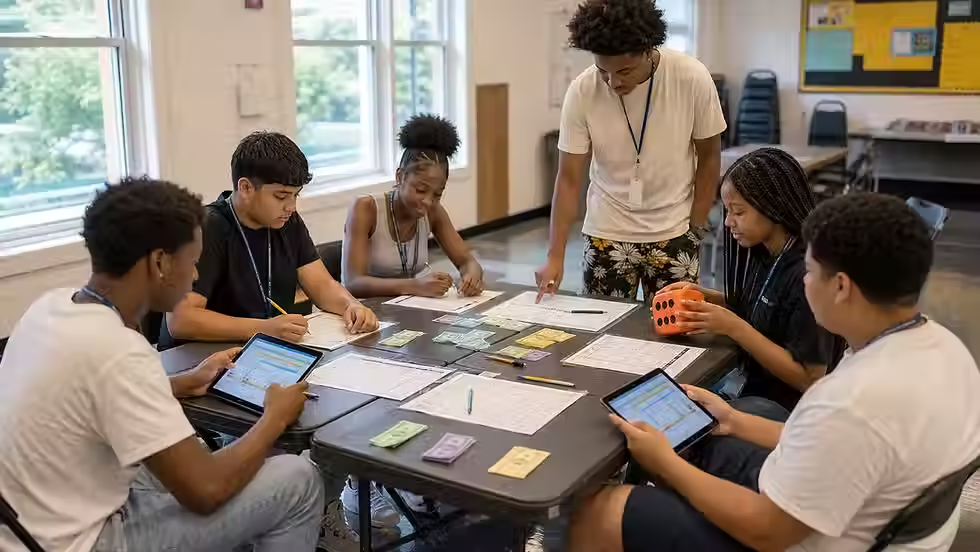
Diapers 2 Deposits, Inc. (D2D) is bringing its Money Club to Baltimore homeschool families this fall, in partnership with The Garden of Becoming. The club meets four Tuesday mornings, October 20 through November 10, 2026, at D2D headquarters, 1 W Overlea Ave #1, Baltimore, MD 21206.
It's homeschool financial literacy for elementary-age students, and it starts with credit instead of budgeting. Enrollment closes Friday, October 16.
Key Takeaways
The D2D Homeschool Money Club meets four Tuesdays, October 20, October 27, November 3, and November 10, 2026, from 10:00 a.m. to 12:00 p.m. at 1 W Overlea Ave #1, Baltimore, MD 21206.
Enrollment for the D2D Homeschool Money Club closes October 16, 2026, at d2dmoneyhub.com/enrollment.
The Money Club teaches elementary-age homeschool students how credit scores are built, how interest works as the cost of borrowing, and how borrowers and lenders relate.
D2D teaches credit before budgeting, a sequencing choice that sits alongside Maryland's 2026 draft standards, which start Credit & Debt Management at a K-2 grade band.
The program is a partnership with The Garden of Becoming, a Baltimore community initiative led by Tasha Hickey that supports and connects Black homeschool families.
What is the D2D Homeschool Money Club?
The D2D Homeschool Money Club is a four-session, credit-first financial literacy program for elementary-age homeschool students, run by Diapers 2 Deposits in partnership with The Garden of Becoming. Sessions meet Tuesdays from 10:00 a.m. to 12:00 p.m., October 20 through November 10, 2026, at D2D headquarters in Baltimore.
Each session runs two hours in a small group. That's enough time to introduce a concept, work through it, and come back to it before kids go home.
The Money Club is built to sit next to what homeschool families already teach, not replace it. Parents keep running their own math and reading. The club adds a structured block of homeschool financial literacy that most home curricula skip.
D2D isn't new to homeschoolers at this address. The organization has run a homeschool drop-off program in Baltimore County from its Overlea location since 2024. D2D was founded by Whitney Ramirez, an Accredited Financial Counselor (AFC®).
What does the Money Club teach elementary students?
The Money Club teaches four things: what a credit score is and how it's built, how interest works as the cost of borrowing, how borrowers and lenders relate to each other, and how to run everyday money choices through a decision-making framework. Every session pairs a concept with time to apply it.
Here's the curriculum at a glance:
Topic | What students work on |
Credit scores | What a credit score is and how it gets built over time |
Interest | Why borrowing money costs money, and how that cost grows |
Borrowers and lenders | Who lends, who borrows, and what each side expects |
Decision-making | Using a framework to weigh everyday money choices |
The Money Club curriculum runs on D2D's F.A.S.T. Framework (FinancialField Trips®, Applications, Standards, Theory). The framework is D2D's own teaching model, and it's the same one used in the organization's school and community programs.
The "Standards" piece matters for homeschool families who track coverage. F.A.S.T. lessons are aligned to state standards, which makes the club easier to document in a portfolio review.
D2D's FinancialField Trips® are the trademarked experiential side of the framework, where students visit banks, dealerships, and workplaces to see money decisions happen in person.
Why does D2D teach credit before budgeting?

D2D leads with credit because most people meet credit products before anyone explains how they work. Teaching the mechanics first, what a score measures and why borrowing costs money, gives students a frame for every later lesson on saving, spending, and budgeting. Most elementary money lessons run in the opposite order.
That order is a deliberate choice, and the state is moving in a similar direction. Maryland's 2026 draft personal financial literacy standards list Credit & Debt Management as one of eight standards, and the Maryland State Department of Education draft runs every one of those standards from a K-2 grade band through grade 12.
The 2011 standards they replace started at grade 3. D2D covered the full set of changes in its breakdown of Maryland's draft personal financial literacy standards.
Timing matters too. The Consumer Financial Protection Bureau's youth financial capability model places ages 6 to 12 in middle childhood, the stage when financial habits and norms really start to take shape as children watch how family members and peers handle money.
What credit-first does not mean
Credit-first doesn't mean elementary students are learning to shop for loans. The same CFPB model puts the heavier financial knowledge and decision-making skills in the teen years.
What a seven- or nine-year-old can carry forward is the idea itself: borrowing has a cost, a credit score is a record, and lenders make decisions based on that record. Budgeting lessons land differently once a student already knows that.
Coin and bill counting is a separate skill, and it's covered elsewhere. Maryland's revised math standards put the value of the penny, nickel, dime, and quarter, plus the $1, $5, $10, and $20 bills, into Grade 1 (standard 1.GR.C.6). Our look at the new Maryland math standards for K-2 explains what changed.
Parents who want to reinforce credit at home can start with D2D's guide to the biggest mistakes parents make when adding a child as an authorized user.
How did the partnership with The Garden of Becoming start?
The Money Club partnership grew out of a Homeschool Panel Discussion that The Garden of Becoming hosted on September 5, 2026, at the Enoch Pratt Free Library Northwood Branch in Baltimore. The panel brought veteran homeschoolers, new families, and home-educated students together, and families could sign up for programs on site. The Money Club came out of that connection.
The Garden of Becoming is a Baltimore-based community initiative and resource collective led by creative organizer Tasha Hickey. The Garden of Becoming supports and connects Black homeschool families through local events, panel discussions, and collaborative literacy groups.
The Garden of Becoming's events include "I Want to Homeschool, Now What" panel discussions and multigenerational literacy meetups. The focus is local: building community, sharing practical homeschooling strategies, and giving families a place to ask questions of people who've already done it.
At the September 5 panel, experienced home educators and home-educated students shared tips, personal stories, and practical resources with families still deciding whether homeschooling fits them.
Money Club schedule, location, and how to enroll
The D2D Homeschool Money Club runs four sessions on consecutive Tuesdays, each from 10:00 a.m. to 12:00 p.m., at 1 W Overlea Ave #1, Baltimore, MD 21206. Enrollment closes October 16, 2026, four days before the first session. Families enroll online at d2dmoneyhub.com/enrollment.
Session | Date | Time |
1 | Tuesday, October 20, 2026 | 10:00 a.m. to 12:00 p.m. |
2 | Tuesday, October 27, 2026 | 10:00 a.m. to 12:00 p.m. |
3 | Tuesday, November 3, 2026 | 10:00 a.m. to 12:00 p.m. |
4 | Tuesday, November 10, 2026 | 10:00 a.m. to 12:00 p.m. |
Location: D2D headquarters, 1 W Overlea Ave #1, Baltimore, MD 21206. Get directions.
Phone: (844) 707-2889
Enroll: d2dmoneyhub.com/enrollment by October 16, 2026.
Families who can't make Tuesday mornings can see D2D's other financial literacy classes for kids, including online and homeschool group options.
Frequently asked questions
Who is the D2D Homeschool Money Club for?
The Money Club is for elementary-age homeschool students in the Baltimore area. D2D offers the program in partnership with The Garden of Becoming, a Baltimore community initiative that supports Black homeschool families.
When does Money Club enrollment close?
Enrollment closes October 16, 2026. The first session is October 20. Families enroll at d2dmoneyhub.com/enrollment, and questions go to (844) 707-2889.
Why does the Money Club teach credit before budgeting?
D2D teaches credit first because understanding how credit works before meeting credit products gives students a structural advantage they carry forward. Budgeting, saving, and spending lessons make more sense once a student knows that borrowing has a cost.
How long are Money Club sessions?
There are four sessions, each two hours long, on Tuesdays from 10:00 a.m. to 12:00 p.m.: October 20, October 27, November 3, and November 10, 2026.
What is The Garden of Becoming?
The Garden of Becoming is a Baltimore-based community initiative and resource collective led by Tasha Hickey. It supports and connects Black homeschool families through local events, panel discussions, and collaborative literacy groups.
What to do before October 16
The Money Club is four mornings of homeschool financial literacy, eight hours total, focused on the part of money most kids never get taught until it's already on a bill.
If your elementary-age student is homeschooled in or near Baltimore, enroll at d2dmoneyhub.com/enrollment before Friday, October 16. Questions about fit or schedule go to D2D at (844) 707-2889.