Two Summers, Two Fall Hires: Inside D2D's YouthWorks Worksite Pipeline


For the second year running, a young person who spent the summer at Diapers 2 Deposits as a MOED YouthWorks participant has been hired into a paid fall position with the organization. Last year it was Owens. This year it was Mackel.
One hire is a nice story. Two in a row, from two different summers, through the same training sequence and the same open hiring process, is a workforce development pipeline. And it is documented.
Here is how the model at D2D actually runs, and why the second hire matters more than the first.
Key Takeaways
Diapers 2 Deposits, Inc. has been an approved Baltimore City YouthWorks worksite for three consecutive summers, 2024 through 2026.
For two consecutive years, a D2D YouthWorks participant was hired into a paid fall position with Diapers 2 Deposits: Owens in 2025 and Mackel in 2026.
D2D youth workers complete D2D's Financial Literacy Instructor certification during their five-week YouthWorks placement, the same preparation adult facilitators complete.
In summer 2026, D2D's nine youth workers helped deliver the Game of Life financial literacy workshop to 166 MOED YouthWorks participants at six Baltimore City locations.
D2D posts its fall openings publicly on Indeed and at diapers2deposits.com/we-are-hiring, and former youth workers compete in the same process as every other applicant.
What is a YouthWorks worksite?
A YouthWorks worksite is an approved organization where Baltimore City residents ages 14 to 21 work paid summer jobs through the Mayor's Office of Employment Development. In 2026, MOED YouthWorks ran for five weeks, from June 29 to July 31, with youth working up to 25 hours a week.
MOED offers two ways to take part. Businesses can hire YouthWorks participants and pay them directly. Nonprofits, community groups, and government agencies can host participants in positions YouthWorks already funds. Diapers 2 Deposits is the second kind: a host worksite.
The program's mission, as the Maryland Department of Labor summarizes it, is to collaborate with youth and employers to create meaningful paid employment opportunities that enhance youth job skills.
That mission sets the goal. It does not tell a worksite what to do with five weeks. Some placements end up as phones and filing. A worksite can also treat those five weeks as a full professional sequence, which is what D2D does.
What youth workers actually do at D2D during the summer
A D2D YouthWorks placement is a professional development sequence with a credential at the end, not a job shadow. Youth workers complete D2D's Financial Literacy Instructor certification, then design program materials, run financial simulations, coordinate with partner sites, and deliver FinancialField Trips® programming to their peers across Baltimore City.
The summer runs in a deliberate order:
Instruction and certification. Youth workers complete the same Financial Literacy Instructor certification that any adult facilitator at D2D earns, alongside their paid YouthWorks hours.
Production. Youth workers design the program materials they will later use in front of their peers.
Coordination. Youth workers write the partner-site emails, build the calendar invites, and manage the logistics of getting sessions delivered.
Delivery. Youth workers run the simulations themselves, live, for other YouthWorks participants.
Application readiness. Each youth worker leaves with a resume, a LinkedIn profile, and help applying for jobs.
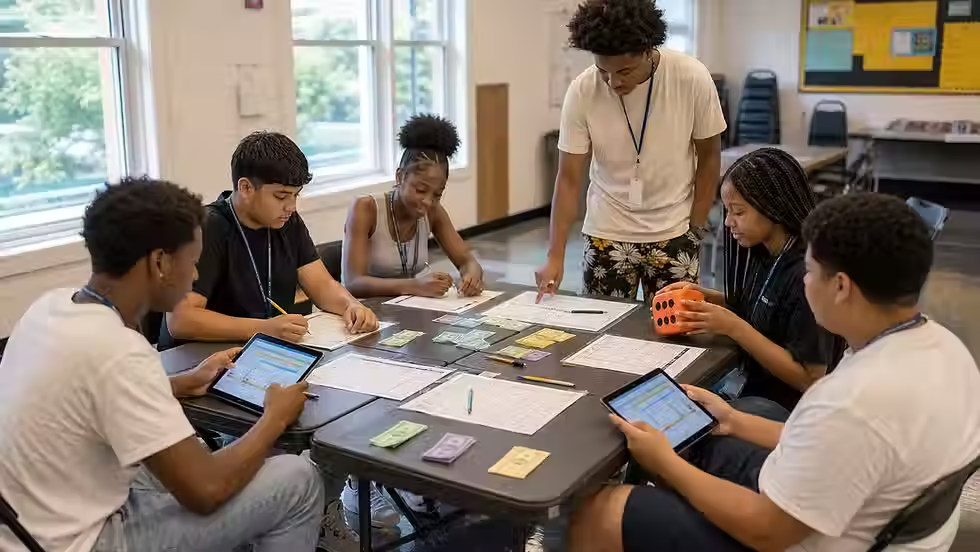
The delivery step is where the summer of 2026 got real. D2D's nine youth workers helped deliver the Game of Life financial literacy workshop to 166 YouthWorks participants at six Baltimore City locations: Keys Dev, Baltimore City Recreation and Parks, MERIT Health Leadership Academy, the Baltimore Police Department, Wildwood Elementary School, and D2D headquarters.
The people running those sessions were teenagers who had finished instructor training weeks earlier. They received their first MOED paycheck on July 17, 2026, and the following Monday they were teaching their peers what to do with one. The four-station simulation they facilitated is the same one D2D runs for schools and agencies year-round.
How a summer placement became a fall job, twice
At the end of each summer, Diapers 2 Deposits helps every youth worker build a resume and LinkedIn profile, supports their job applications, and encourages them to apply when D2D's fall positions open. Owens applied in 2025 and was hired. Mackel applied in 2026 and was hired. Neither received preference.
That last point is the whole argument, so it is worth spelling out.
D2D posts its fall openings publicly on Indeed and on the D2D careers page. Applications are reviewed when the posting closes. Former youth workers get no preference outside that competitive process. They apply next to adult candidates with teaching, coaching, and counseling backgrounds, for roles like the ones described in D2D's financial literacy instructor job overview.
If former youth workers got a shortcut, a fall hire would prove nothing about the summer. Because they compete, the hire is evidence the summer produced a candidate who was ready.
There is a second shift worth noticing. Summer wages come through YouthWorks. The fall position is on Diapers 2 Deposits' own payroll. That is the moment a city-funded summer seat becomes an actual job, and it is the step most summer youth employment programs hope for but rarely get to document.
The career-readiness piece is not new, either. In D2D's first summer as a worksite in 2024, youth workers took a FinancialField Trip to a Baltimore studio for professional headshots and mock interview practice. The resume and LinkedIn work grew out of that.
Why two hires in a row counts as a workforce development pipeline
A workforce development pipeline is a repeatable sequence that moves people from training into employment. One hire can come down to a single standout candidate or good timing. Two consecutive hires, from two different cohorts, through the same sequence and the same open process, show that the sequence itself is producing job-ready candidates.
Here is what each D2D youth worker leaves the summer with, whether or not they apply to D2D:
What they leave with | Where it comes from |
A professional credential | D2D's Financial Literacy Instructor certification |
A resume | Built with D2D staff at the end of the summer |
A LinkedIn profile | Built with D2D staff at the end of the summer |
Documented facilitation experience | Live sessions for YouthWorks participants at partner sites |
A competitive application on file | D2D's public fall hiring round |
Honesty matters here. Two hires is a small number. It is not a placement rate, and Diapers 2 Deposits is not claiming one. D2D hires a limited number of fall staff each year, so most youth workers will take their resumes and credentials somewhere else. That is the point of building them.
D2D is also not the only worksite to hire a YouthWorker after the summer. The University of Maryland, Baltimore has written about a YouthWorks participant it later hired as a web developer. What the D2D case adds is repetition: the same sequence, two consecutive years, two named outcomes.
What other YouthWorks worksites can take from this model
Nothing about the D2D model depends on financial literacy. Any host organization can give summer staff a credential, real production work, real coordination responsibility, live delivery, and help applying for jobs, then post its own openings publicly and let youth workers compete on equal terms.
Element | What it looks like at D2D | Why it matters |
A credential | Financial Literacy Instructor certification | Gives the youth worker something portable |
Real production | Designing program materials | Produces work they can show an employer |
Real responsibility | Partner emails, calendar invites, session logistics | Makes the supervisor reference specific |
Live delivery | Facilitating for 166 YouthWorks participants | Turns training into documented experience |
Application support | Resume, LinkedIn profile, job applications | Removes the paperwork barrier to applying |
Open hiring | Public postings, reviewed at close | Makes a resulting hire mean something |

The open hiring step is the one other worksites tend to skip. It is also the one that turns a good summer into evidence.
Frequently asked questions
Who can participate in Baltimore's MOED YouthWorks program?
Baltimore City residents ages 14 to 21. In 2026 the program ran June 29 to July 31, with youth working up to five hours a day and 25 hours a week. The YouthWorks application opens in early January each year.
Do former YouthWorks participants get preference for jobs at Diapers 2 Deposits?
No. D2D posts fall openings publicly on Indeed and its careers page and reviews applications when the posting closes. Former youth workers are encouraged to apply but compete in the same process as every other candidate.
What is D2D's Financial Literacy Instructor certification?
It is the instructor preparation Diapers 2 Deposits requires of its facilitators. YouthWorks participants at D2D complete it during their summer placement, alongside their paid hours, before they facilitate sessions for their peers.
How does an organization become a YouthWorks worksite?
Through the Mayor's Office of Employment Development. Nonprofits, community groups, and government agencies can host participants in funded positions, and businesses can hire participants directly. Contact details for both routes are on MOED's YouthWorks Summer Jobs page.
Where the pipeline goes from here
Three summers as an approved worksite. Two consecutive fall hires. The same sequence both times: instruction, certification, production, coordination, delivery, and application readiness, inside a five-week summer youth employment season.
Two young people have now crossed from YouthWorks participant to D2D employee, hired on merit through an open process. That is what workforce development looks like when a worksite takes the mission seriously.
Looking for a role? See current openings at Diapers 2 Deposits. Running a youth program, school, or agency and want the Game of Life workshop or FinancialField Trips® at your site? Start with financial literacy programs for organizations.