Title I, Community School, or Concentration of Poverty? What the Labels Mean for Your Maryland School


Your school's website says Title I. A flyer from the front office says community school. A budget sheet mentions Concentration of Poverty. If all three came up in your last planning meeting, you're not the only one who left unsure what each one means.
Here's the fix. Those are two programs, not three. Title I is federal, Maryland community schools are a state creation, and plenty of schools carry both.
Title I is a federal program: districts rank schools by poverty and send the highest-poverty ones extra federal money. A community school is a Maryland label for any school receiving the state's Concentration of Poverty Grant, which pays for a coordinator, a health care practitioner and wraparound services. Many high-poverty schools are both.
Attribute | Title I school | Community school |
|---|---|---|
Who sets it | Federal law (ESEA Title I, Part A) | Maryland law (Education Article 5-223 and Title 9.9) |
Who picks the schools | Each district, every year | A state formula, every year |
Poverty measure | District's choice, usually free and reduced-price meals or direct certification | Compensatory education enrollment, averaged over the 3 prior school years |
Cutoff | 40% for a schoolwide program; district cutoffs often run higher | Above 55% for per-pupil money in 2026-27; full rate at 80% |
What the money pays for | Extra instruction, staff, family engagement | A coordinator, health care coverage, then wraparound services |
Who runs it at school | Principal and the district Title I office | Community school coordinator |
How many in Maryland | 504 schools (2024-25) | 621 schools (fiscal 2024) |
Key takeaways
Title I is a federal program, and each Maryland district decides which of its schools get Title I money. MSDE listed 504 Title I schools in Maryland for 2024-25.
In Maryland, any public school that receives the state's Concentration of Poverty Grant is a community school. MSDE counted 621 community schools in fiscal 2024.
Concentration of Poverty is a percentage and a grant, not a third kind of school. In 2026-27, per-pupil grant money reaches schools above 55 percent.
A school can be both. In Montgomery County, all 47 schools on MSDE's 2024-25 Title I list also appear on MCPS's list of 77 community schools.
Title I questions go to the principal and district Title I office. Community school questions go to the community school coordinator.
What is a Title I school in Maryland?
A Title I school in Maryland is a public school that gets extra federal money under Title I, Part A of the Elementary and Secondary Education Act because many of its students come from low-income families. The district, not the state, ranks its schools by poverty each year and decides which ones it can serve.
Title I schools run one of two kinds of programs:
Schoolwide program. A school with at least 40 percent of students in poverty can use Title I money to improve the whole school, according to MSDE's Title I program guide.
Targeted assistance program. A Title I school below that line serves only the students most at risk of falling behind state standards.
The 40 percent line is a floor, not a promise. Districts fund their highest-poverty schools first and stop when the money runs out. For 2026-27, Montgomery County Public Schools set its Title I cutoff at 40.6 percent of students directly certified for free meals in elementary schools and 41.3 percent in middle schools.
Direct certification means a student qualifies for free meals automatically because the household gets SNAP, Medicaid or similar benefits, or because the student is in foster care or experiencing homelessness.
Other districts draw the line much higher. Baltimore County's Title I programs served elementary schools at 61 percent poverty or above, middle schools at 55 percent and high schools at 75 percent in 2023-24, according to BCPS.
Maryland had 504 Title I schools in 2024-25, 481 of them schoolwide, according to MSDE's list of Title I schools. Baltimore City had 119 and Prince George's County 107. The federal money behind the label is already set for this school year, as we explained in where Title I funding stands for 2026-27.
What is a community school in Maryland?
A community school in Maryland is any public school that receives the state's Concentration of Poverty Grant under the Blueprint for Maryland's Future. The grant first pays for a community school coordinator and full-time health care coverage. After that, it pays for wraparound services the school chooses through a needs assessment.
Maryland law defines a community school as "a public school that establishes a set of strategic partnerships between the school and other community resources" to support achievement, learning conditions and the well-being of students and families. That's Education Article 9.9-101. In practice, the grant is what makes the label official.
A Maryland community school has four required pieces:
A community school coordinator, who runs the partnerships and the plan.
A health care practitioner, with full-time coverage at the school.
A needs assessment, completed within a year of becoming a community school.
An implementation plan, built from the needs assessment, that steers the per-pupil money toward services like health care, mental health support, family resources and extended learning.
MSDE counted 621 Maryland community schools receiving the grant in fiscal 2024, according to its Blueprint community schools page. Baltimore City had 152, Prince George's County 131 and Baltimore County 92. The fiscal 2027 budget as introduced held $572.7 million for the grant.
Community schools are one part of a much larger law. We looked at another part in how the Blueprint for Maryland's Future handles financial literacy.
What "Concentration of Poverty" actually means
Concentration of Poverty is a school's poverty percentage, and also the name of the state grant that percentage unlocks. It isn't a third label. A school's concentration of poverty is its compensatory education enrollment averaged over the three prior school years, with 2020-21 left out. MSDE describes that enrollment as essentially the count of students receiving free and reduced-price meals.
The Concentration of Poverty Grant comes in two parts. The personnel grant was set at $248,833 per eligible school in fiscal 2022 and rises with inflation each year, under Education Article 5-223. The per-pupil grant pays nothing at or below 55 percent, rises on a sliding scale above that, and reaches its maximum at 80 percent.
The eligibility line dropped five points a year:
Concentration of poverty | Personnel grant began | Per-pupil grant began |
|---|---|---|
80% or more | FY2020 | FY2022 |
75% to 80% | FY2021 | FY2023 |
70% to 75% | FY2022 | FY2024 |
65% to 70% | FY2023 | FY2025 |
60% to 65% | FY2024 | FY2026 |
55% to 60% | FY2025 | FY2027 |
Source: the Department of Legislative Services fiscal note on HB 352. Maryland's fiscal 2027 runs July 1, 2026 to June 30, 2027, so it lines up with the 2026-27 school year.
If you've seen an 80 percent threshold quoted somewhere, it's out of date. That was the starting line in fiscal 2020.
New community schools also don't get the full per-pupil amount right away. A school gets 16 percent in its first year of eligibility and 100 percent by its seventh. Starting in fiscal 2030, every eligible school gets 100 percent.
Can a school be both Title I and a community school?
Yes, and in some districts nearly every Title I school is also a community school. Both labels follow poverty, but they use different measures, different cutoffs and different decision-makers. So the two lists overlap without matching, and a school can be both, either one, or neither.
Montgomery County shows how far the overlap can go. We compared MSDE's 2024-25 list of Title I schools with MCPS's list of 77 community schools. All 47 MCPS Title I schools are on the community school list. The other 30 community schools aren't Title I, and seven of those 30 are high schools, including Wheaton and Springbrook.
Two of our own fall sites show the split. D2D's Millionaire's Club runs at Forest Oak and Neelsville middle schools. Forest Oak is on both lists. Neelsville is a community school but not a Title I school.
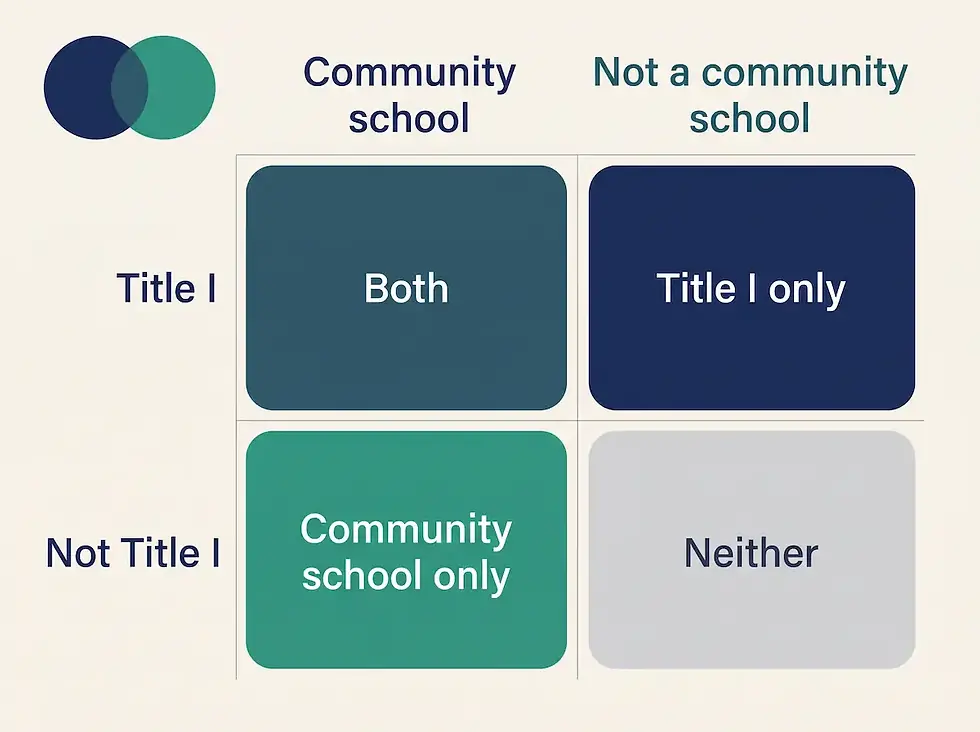
Title I status | Community school | Not a community school |
|---|---|---|
Title I | Both labels, like Forest Oak Middle | Above the district's Title I cutoff, below the state's 55 percent line |
Not Title I | Community school only, like Neelsville Middle | Neither label |
One district isn't the whole state. A district with a high Title I cutoff, like Baltimore County's 75 percent for high schools, can have many community schools that aren't Title I.
Title I money has to add to state and local money, not replace it. MSDE's guide calls this the supplement-not-supplant rule. That's why a school with both labels keeps the two budgets separate. The district Title I office decides how the two are layered.
How to check which labels your school has
Check two lists. MSDE posts a list of Title I schools each year, and most districts post their community schools. If the school's website mentions neither, ask the principal. Title I schools are required to hold an annual meeting that explains the program to families, so the answer shouldn't be hard to get.
Find the Title I list. Search MSDE's site for its list of Title I schools for the current year, or use the 2024-25 list.
Find the community school list. Start with MSDE's Blueprint community schools page, then check your district's community schools page.
Check the school's website. Title I schools usually post a Title I page with the schoolwide plan and the family engagement policy.
Ask the district Title I office for this year's cutoff. Cutoffs move every year, and a school near the line can gain or lose Title I status.
Who to talk to about funding a program at your school
Follow the label to the budget. Title I money runs through the principal and the district Title I office, usually through the schoolwide plan or the family engagement set-aside. Community school money runs through the community school coordinator and the school's needs assessment. A school with both labels has two ways in.
At a Title I school, start with the principal. A family program can come out of the 1 percent family engagement set-aside, as in our guide to a family money night paid from Title I family engagement funds.
At a community school, start with the community school coordinator. Ask whether the needs assessment names the gap your program fills.
At a school with both, talk to both. The money comes from different budgets, and one may have room when the other doesn't.
Under current law, the Concentration of Poverty Grant can also pay for some state-required programs, such as fine arts, through fiscal 2027. A 2026 bill to extend that past 2027, HB 352, passed the House 119-9 but didn't become law.
For the full map of federal and state money, see which federal and state funds can pay for financial literacy.
Frequently asked questions
What is a Title I school in Maryland?
A Title I school in Maryland is a public school that receives federal Title I, Part A money because a high share of its students come from low-income families. Each district ranks its schools by poverty and picks which to serve. Maryland had 504 Title I schools in 2024-25.
Why are community schools good?
Community schools are built to handle problems students bring into the classroom, like health needs, hunger and family stress, by bringing partners into the building. The Maryland Center for Community Schools at Towson University calls them an evidence-based strategy built on six key practices. How well one works depends on its needs assessment and partners.
Does being Title I make a school a community school?
No. Title I is a federal program run by the district, and community school status comes from the state's Concentration of Poverty Grant. The two use different poverty measures and cutoffs. Many schools have both labels, but neither causes the other.
Do community schools get more money than Title I schools?
The two aren't directly comparable, because they're separate streams paid for different things. A community school's personnel grant started at $248,833 per school in fiscal 2022, plus per-pupil money above 55 percent poverty. A Title I school's amount depends on its district's allocation and student counts. A school with both labels gets both.
Where to start
Check both lists for your school, then talk to the person who controls each budget. The principal and Title I office handle one budget. The community school coordinator handles the other.
Diapers 2 Deposits runs financial literacy programs in Title I schools and community schools across Maryland, and we can help you match a program to the right budget. See how we work with schools.


