Financial Literacy for Military Kids: Lessons From an Army Post


Before the buses, before the trademark, Whitney Ramirez taught money to soldiers.
Not to nine-year-olds. To grown service members at an Army post in Prince George County, Virginia, most of them early in their careers, most of them handling a steady paycheck, a benefits package, and life away from home for the first time all at once.
That room is where the thinking behind Diapers 2 Deposits actually started, including how we approach financial literacy for military kids. Because the soldiers who struggled most were not careless with money. Nobody had ever walked them through how the system works before it started working against them.
The classroom that came before the bus
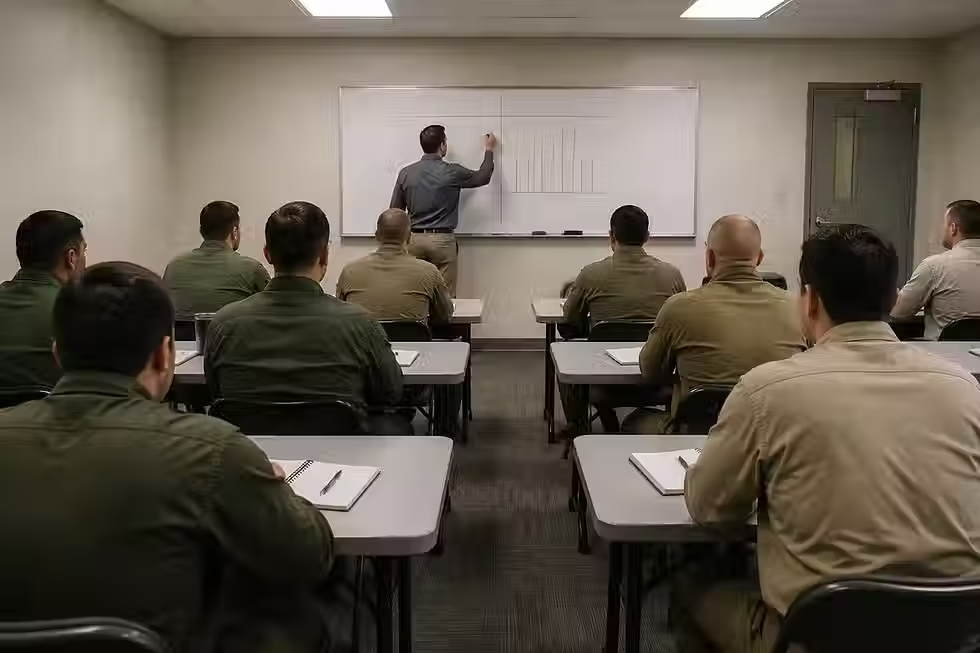
Whitney is an Accredited Financial Counselor (AFC®), a credential that takes an exam plus a thousand logged hours of counseling before anyone can put the letters after their name. She earned it, then spent time as a Department of Defense contractor teaching personal financial management to U.S. service members.
The post she taught on is in Prince George County, Virginia. It was renamed Fort Gregg-Adams in 2023 and renamed again in 2025, and it is currently Fort Lee, after Private Fitz Lee, a Buffalo Soldier and Medal of Honor recipient. Names aside, the mission has not moved. It is one of the Army's main logistics and sustainment training sites, which means a constant flow of junior soldiers cycling through.
That detail matters more than it sounds. First duty station, first real paycheck, first time nobody is checking your bank balance for you. Financial habits get set in that window and they tend to hold.
Whitney's own path to this work was not a straight line either. She spent close to two decades in public transportation, starting at 19 with the New York City Transit Authority, then Maryland, then Washington, D.C. She left a secure career at 36 with one stubborn idea: take young people to the money instead of teaching it on a worksheet. Then she bought a bus and built FinancialField Trips® around it.
Why the military already treats money as a readiness issue
This is not a soft topic inside the DoD. It is policy.
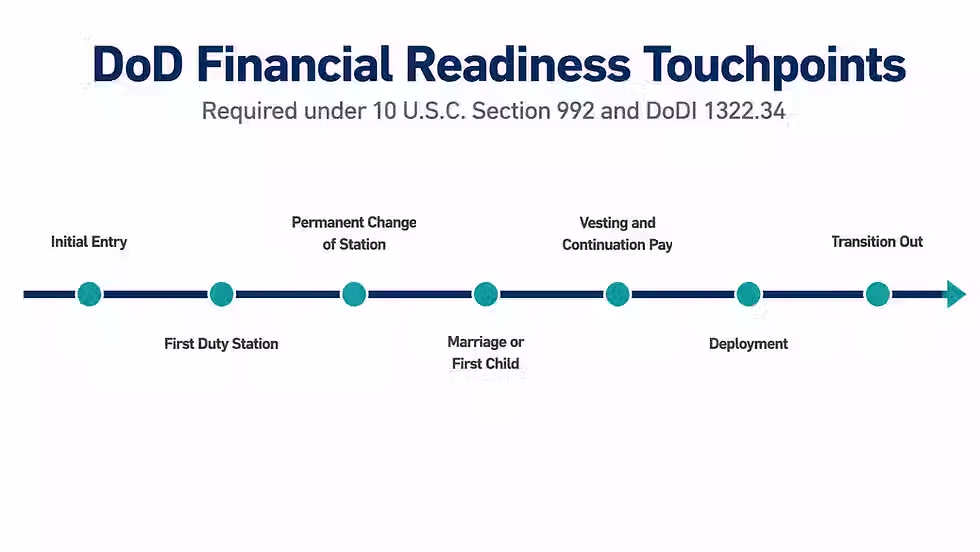
Under DoD Instruction 1322.34, service members receive financial literacy training at defined touchpoints across a career: initial entry, arrival at the first duty station, every PCS, marriage, the birth of a first child, deployment, promotion into leadership, and transition out of service. The requirement traces back to statute, not to a wellness initiative someone launched one year and quietly shelved the next.
The reason is practical. Money stress pulls focus off the mission, and it carries professional weight most civilians never have to think about. Financial problems are consistently the most cited concern in security clearance denials and revocations, which is why a late payment is never really just a late payment for a cleared service member.
Money readiness is mission readiness. The military figured that out a long time ago. What it has not fully solved is what happens to the kids in the same household.
What military kids get, and what they miss
There are roughly 1.6 million military children in the United States. They are resilient in ways that surprise people. They adapt fast, they read a room quickly, and they watch a parent model discipline every single day.
They also move every two to three years, six to nine times across their school years, which is about three times the rate of their civilian classmates. Most of them attend local public schools, so whatever personal finance instruction they get depends entirely on which state and which district they happened to land in that year.
Financial education, in other words, is one of the few things in a military kid's life that does not travel with them.
Meanwhile they are watching the money side of every move up close. A Military Family Advisory Network survey from late 2025 found that 60% of active duty families who had moved in the previous two years paid more than $1,000 out of pocket beyond what they were reimbursed, up from 45% two years earlier. Deposits, hotel stays, replacing the consumables the movers would not ship. Kids notice. They just don't have the vocabulary yet for what they are noticing.
Why credit comes before budgeting
Most financial education for young people opens with a budget worksheet. D2D does not, and the reason is specific.
Credit is the invisible gate. It decides whether a family gets approved for the rental near the good school, whether the second car happens, whether a background check turns into a job offer. All of that gets decided before a budget has any say in it. For a family that is about to PCS across the country, or a veteran turning service into a civilian career, sequencing credit first is not a stylistic preference. It changes what doors are open when you arrive.
As Whitney puts it: "Credit card interest is optional, if you know how the system works. If you don't, that diploma you worked so hard for becomes a debt sentence."
That is the same lesson she taught to soldiers, scaled down and made age-appropriate for young people ages 9 to 24. The content changes. The sequence does not.
Keeping money skills consistent between duty stations
The gap for military families is continuity, not effort. Here is what actually holds up across a move:
Use the PCS as the lesson. The move is already a live financial event with real numbers attached. Deposits, mileage, what got reimbursed and what didn't. Walk your kids through the actual math instead of protecting them from it.
Pick a format that travels. Virtual FinancialField Trips® exist for exactly this reason. A scholar can join from a hotel room in the middle of a move and pick up where they left off, which a school-based program cannot promise.
Keep one running record. A single place where progress lives, so the next duty station starts at the next lesson rather than back at lesson one.
Use the counselors you already pay for. Every installation has personal financial counselors available at no cost to the family. Most families use them once, during in-processing, and never again.
Say the numbers out loud. Kids learn money the way they learn language, by hearing it used correctly by adults who are not performing for them.
The F.A.S.T. Framework and the experiential model behind it were built so a lesson learned at one duty station does not get left behind at the next. That is the whole design brief.
FAQ
What age should military kids start learning about money?
Earlier than most parents expect. D2D works with young people from age 9 through 24, and the early sessions are less about products than about how money moves and who decides. The military itself starts formal financial training at a service member's first day, which tells you something about when the habit window opens.
Do financial problems really affect a security clearance?
Yes. Financial Considerations, listed as Guideline F in the federal adjudicative guidelines, is consistently the most frequently cited concern in clearance denials and revocations. Debt by itself is not disqualifying. Unaddressed, unexplained debt is the problem. We covered this in more depth in our piece on financial readiness and late payments.
Can military families join if they are not near Baltimore?
Yes. The virtual format was built for families who move, deploy, or live nowhere near a D2D site. It runs the same curriculum as the in-person experience.
What free financial help do military families already have?
Every installation has personal financial counselors and family center staff who provide one-on-one help at no cost, and the DoD-mandated touchpoint training is available at each career milestone. Those services cover the service member well. They are not designed to teach the children in the household, which is the gap D2D fills.
Where a military family can start
You do not have to already know this. That was Whitney's message to soldiers in a Virginia classroom, and it is the same message to the families reading this now.
The strongest thing a military household can do for financial literacy for military kids is pick a format that survives the next set of orders, then start before the next move rather than after it. Continuity beats intensity.
A lesson every month that follows the family is worth more than a great one-day workshop the kids leave behind at the old duty station.
If you are a base program lead, school liaison, or defense partner looking at this from the institutional side, the Diapers 2 Deposits capability statement for military and defense partners covers scope, credentials, and delivery models. Families can start directly at d2dmoneyhub.com or through our financial literacy classes for parents.
Whitney Ramirez is an Accredited Financial Counselor (AFC®), a former Department of Defense financial education instructor, and the Founder and CEO of Diapers 2 Deposits, Inc. She describes the work as building the infrastructure of economic freedom for a generation. More at whitneyramirez.com and on her founder profile.
