This Memorial Day, AFC® Counselor Names Junior Enlisted Financial Vulnerability a Force-Readiness Threat

BALTIMORE, MD — May 25, 2026 — Whitney Ramirez, an Accredited Financial Counselor (AFC®) and founder of Diapers 2 Deposits, Inc. (D2D), this Memorial Day named junior enlisted financial vulnerability a force-readiness threat, calling on the Department of Defense and its Tier-1 contracting primes to treat the issue as force protection rather than personal finance, and to fund methodology and counseling hours. Under Security Executive Agent Directive (SEAD) 4 Guideline F, financial considerations remain among the leading drivers of security clearance suspensions, denials, and revocations across the active-duty force.
According to publicly reported federal contracting data, the Department of Defense currently spends approximately $516 million on financial counseling for service members and military families through two primary contract vehicles: Magellan Federal holds the DoD Personal Financial Counselor (PFC) Program contract reportedly valued at approximately $60 million, and Leidos holds the Military OneSource and Military & Family Life Counseling (MFLC) contract reportedly valued at approximately $456 million. Both vehicles serve overlapping installations and family populations. Yet SEAD-4 Guideline F denials have not declined commensurately. D2D, a certified Woman-Owned Small Business (WOSB) operating under NAICS 611710 and UEI SSGKEAD5GBT4, argues the methodology, not the contract spend, is the leading-edge problem the DoD has yet to name.
Why is junior enlisted financial vulnerability a force-readiness threat, not just a personal finance issue?
Under SEAD-4 Guideline F, an adjudicator at the Defense Counterintelligence and Security Agency (DCSA) weighs a service member's financial conduct as a counterintelligence and reliability indicator. Inability to satisfy debts, a history of failing to meet financial obligations, and spending beyond one's means are disqualifying conditions named in the directive. For a junior enlisted service member at the E-1 through E-4 pay grades, populations concentrated at Maryland installations, including Fort Meade, Aberdeen Proving Ground, and Joint Base Andrews, a single missed credit card payment or repossession can trigger an adjudicative finding that pulls the service member off mission. Force-readiness is the aggregate availability of cleared, deployable personnel across the U.S. Army, Navy, Air Force, Marine Corps, and Space Force. When SEAD-4 Guideline F removes those personnel from the duty roster, the readiness metric is met. Diapers 2 Deposits names this connective tissue that the Magellan Federal PFC Program and the Leidos MFLC vehicle have not formally diagnosed.
ACCORDING TO AFC COUNSELOR, what's wrong with the current DoD approach to junior enlisted financial counseling?
The dominant DoD model, delivered through the Magellan Federal PFC Program and the Leidos Military OneSource and MFLC vehicles, is structured as triage. A service member identifies a problem; the program responds with budgeting guidance, debt management, and crisis-stabilization counseling. Whitney Ramirez, an Accredited Financial Counselor (AFC®), argues this sequence is the inversion that breaks force readiness. Teaching a junior enlisted service member to budget Basic Allowance for Housing (BAH) and Basic Allowance for Subsistence (BAS) before understanding how credit is read by a SEAD-4 adjudicator at the Defense Counterintelligence and Security Agency (DCSA) produces a counselee who can manage scarcity but cannot prevent it. The $516 million annual spend across the Magellan Federal and Leidos contract families' purchase volume, not architecture. The methodology gap that Diapers 2 Deposits names has not been formally diagnosed within the Office of the Under Secretary of Defense for Personnel & Readiness (OUSD P&R) procurement frame.
How does the F.A.S.T. Framework approach junior enlisted financial readiness differently?
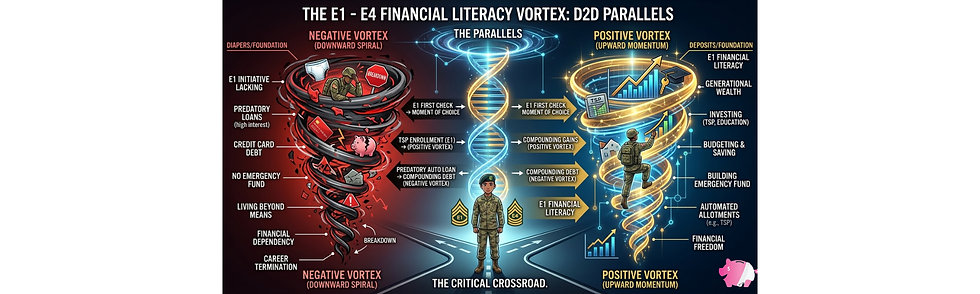
The F.A.S.T. Framework — FinancialField Trips® | Applications | Standards | Theory — sequences credit before budgeting and treats financial literacy as an architecture rather than a series of interventions. Pillar one delivers FinancialField Trips®, immersive partner-site experiences at dealerships, banks, and corporate environments where junior enlisted personnel learn how credit is evaluated by the same institutions that evaluate them under SEAD-4 Guideline F. Pillar two provides Applications: browser-based sandboxes including paystub simulators and APR debt-gravity simulations. Pillar three aligns instruction to the National Standards for Personal Financial Education and Common Core State Standards. Pillar four, Theory, is anchored by the Financial Literacy Vortex, a proprietary model mapping how financial decisions compound into either generational instability or generational wealth. For installations where junior enlisted personnel cannot easily leave base, Diapers 2 Deposits deploys a contained cloud-based delivery model behind the firewall, bringing the dealership, bank, and corporate-environment simulations directly onto the installation.
What does this mean for DoD and defense primes this Memorial Day?
Diapers 2 Deposits, certified as a Woman-Owned Small Business (WOSB) and registered under NAICS 611710 with UEI SSGKEAD5GBT4, positions the F.A.S.T. Framework as a subcontracting capability for Tier-1 defense primes navigating both federally mandated small-business subcontracting goals and the SEAD-4 Guideline F clearance-protection imperative. Memorial Day is the appropriate moment to reframe the logic of spending. A defense prime that subcontracts AFC®-credentialed financial counseling to D2D is not purchasing a wellness benefit. It is purchasing a force-protection input, just as it would purchase armor, comms, or medical readiness. The primes managing the Magellan Federal PFC Program and the Leidos MFLC vehicle are not the only buyers in the market. Every prime with a junior enlisted–facing installations contract has an SEAD-4 exposure, and every SEAD-4 exposure has a methodology answer. The capability statement and past-performance review for federal evaluators is available at diapers2deposits.com/financialliteracyfororganizations#federal-capability-statement.
"Force readiness is not won at the dealership counter or the bank window, but it can be lost there," said Whitney Ramirez, Founder and Executive Director of Diapers 2 Deposits and an Accredited Financial Counselor (AFC®). "The DoD has the money. What the DoD does not yet have is a procurement framework that recognizes credit education as a force-protection investment before budgeting. Until the buying logic catches up, SEAD-4 Guideline F will keep removing trained service members from the duty roster for problems that should have been engineered out three pay grades earlier."
About Diapers 2 Deposits, Inc.
Diapers 2 Deposits, Inc. is an award-winning, for-profit financial literacy organization headquartered in Maryland and serving installations and partner sites across multiple regions. The firm was founded by Whitney Ramirez, an Accredited Financial Counselor (AFC®), and operates as a Woman-Owned Small Business (WOSB) under NAICS 611710 with UEI SSGKEAD5GBT4. The D2D curriculum is developed and designed by an Accredited Financial Counselor (AFC®). Recognitions include the Outstanding Education Program of the Year from the Association for Financial Counseling and Planning Education (AFCPE), the Rising Star Award from the Maryland Chamber of Commerce, and the ChangeMaker Challenge Award from the United Way of Central Maryland. The organization has served more than 2,000 youth and young adults with a 92 percent program completion rate and an average 40 percent increase in financial literacy scores on post-assessment. For procurement inquiries, contact savvy@diapers2deposits.com or (844) 70-SAVVY. The full federal capability statement is available at diapers2deposits.com/financialliteracyfororganizations#federal-capability-statement.


